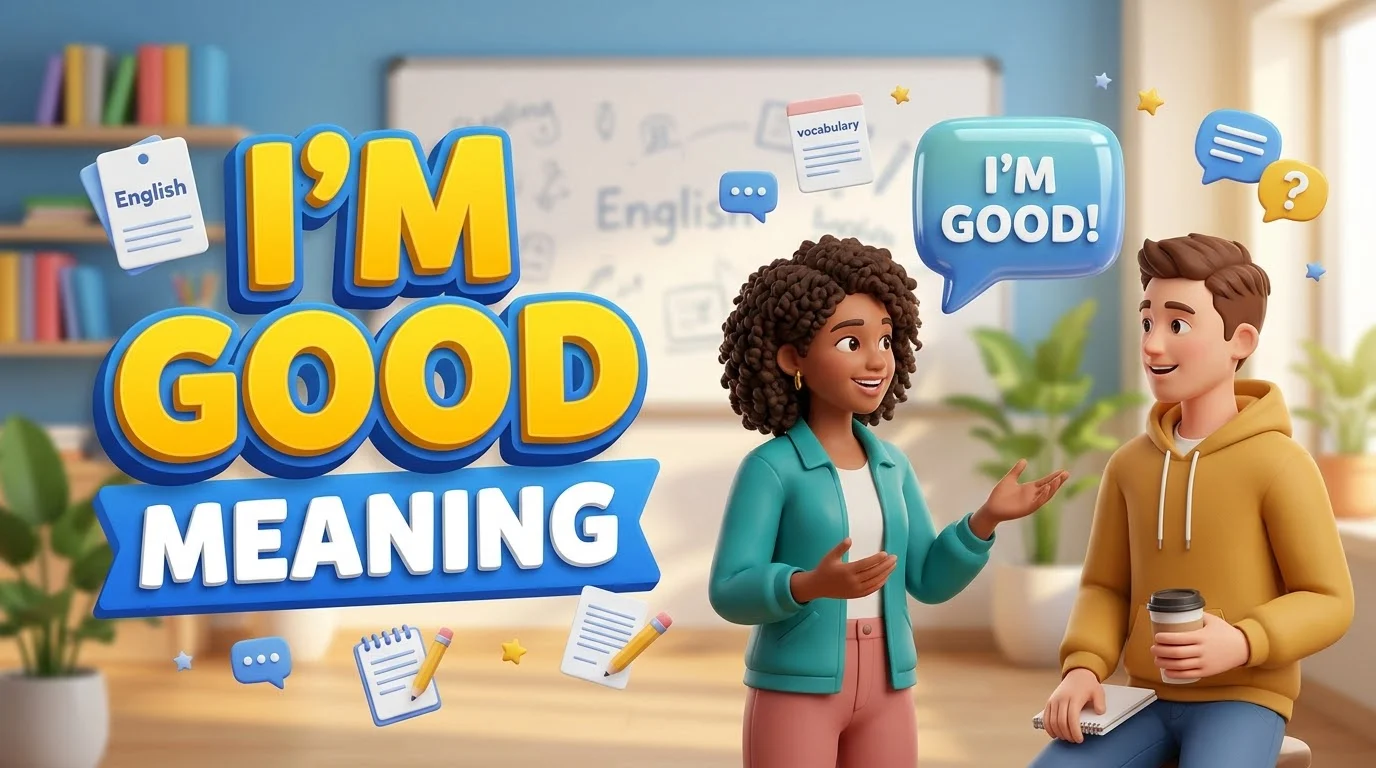
The phrase “I’m good” usually means “I’m fine,” “I’m doing well,” or “I don’t need anything.” It is a common expression in everyday American English. People use it when someone asks how they are feeling, offers them something, or checks if they need help. For example, if someone asks, “How are you?” you can simply reply, “I’m good.” Similarly, if a friend offers you another cup of coffee, saying “I’m good” politely means you do not want more.
Although the expression sounds simple, its meaning can change depending on the situation and tone of voice. It can describe your feelings, express satisfaction, or politely refuse an offer. Understanding the grammar, context, and different uses of “I’m good” will help you communicate more naturally and confidently in English.
Quick Answer: What Does “I’m Good” Mean?
“I’m good” means “I’m fine,” “I’m doing well,” or “I don’t need anything.” It is an informal expression commonly used in American English. You can say it when someone asks how you are, offers you something, or asks if you need help.
1. What Does “I’m Good” Mean in English?
“I’m good” is a conversational English expression used to communicate that everything is fine or that you are satisfied with a situation.
The phrase has several meanings depending on the context:
- I’m fine: You feel okay physically or emotionally.
- I’m doing well: Things are going well in your life.
- No, thank you: You politely refuse an offer.
- I don’t need help: You can manage something yourself.
- I’m satisfied: You have everything you need.
For example:
Person A: How are you feeling today?
Person B: I’m good, thanks!
Here, the speaker means they feel fine.
Another example:
Person A: Would you like another slice of pizza?
Person B: I’m good, thanks.
In this situation, the speaker means they do not want another slice.
2. Definition of “I’m Good”
The expression “I’m good” combines the subject “I,” the verb “am,” and the adjective “good.”
Simple definition: I’m good means that I am fine, okay, satisfied, or not in need of anything.
It is widely used in casual conversations, text messages, social situations, and everyday communication.
Different meanings of “I’m Good”
| Meaning | Explanation | Example |
|---|---|---|
| I’m fine | Feeling okay | I’m good today. |
| I’m happy | Feeling positive | I’m good and excited! |
| No, thanks | Refusing politely | I’m good, thanks. |
| I’m capable | Not needing help | I’m good on my own. |
| I’m satisfied | Having enough | I’m good with this amount. |
Remember that context determines which meaning the listener understands.
3. Grammar of “I’m Good”
Understanding the grammar of “I’m good” makes it easier to use correctly.
The phrase contains three grammatical elements:
- I: A first-person singular subject pronoun.
- ‘m: A contraction of the verb “am.”
- Good: An adjective describing the subject.
The complete grammatical structure is:
Subject + Linking Verb + Adjective
Example:
- I + am + good.
- I’m + good.
Here, “am” works as a linking verb. It connects the subject “I” with the adjective “good.”
Is “Good” an Adjective?
Yes. In “I’m good,” the word “good” is an adjective because it describes the condition or state of the speaker.
Examples:
- I’m good today.
- I’m good with numbers.
- I’m good at English.
- I’m good enough.
4. What Does “Good” Mean by Itself?
The word “good” has several meanings in English. It can describe quality, behavior, ability, health, or satisfaction.
Good is generally an adjective, although it can also appear in other grammatical expressions.
Examples:
- This is a good book.
- She is a good teacher.
- You did a good job.
- The food tastes good.
- He’s good at football.
In these sentences, “good” describes something positive, suitable, enjoyable, or of high quality.
Common meanings of Good
| Meaning | Example |
|---|---|
| Excellent quality | This is a good phone. |
| Kind behavior | He is a good person. |
| Positive condition | I’m feeling good. |
| Strong ability | She’s good at singing. |
| Suitable or acceptable | This time is good for me. |
5. What Does “I’m Good” Mean in a Conversation?
The meaning of “I’m good” depends on what the other person says before it.
Here are some common conversational situations.
When Someone Asks How You Are
Person A: Hey, how are you?
Person B: I’m good, thanks!
Meaning: I’m fine or doing well.
When Someone Offers You Something
Person A: Do you want some water?
Person B: I’m good, thank you.
Meaning: No, thank you. I don’t need water.
When Someone Offers Help
Person A: Do you need help carrying those bags?
Person B: I’m good.
Meaning: I can manage without help.
When Someone Checks Your Condition
Person A: Are you okay after the accident?
Person B: I’m good.
Meaning: I’m fine or not seriously hurt.
6. “I’m Good” vs. “I Am Good”: What’s the Difference?
Both expressions are grammatically correct and have the same basic meaning. The main difference is their level of formality and emphasis.
| I’m Good | I Am Good |
|---|---|
| Uses a contraction | Uses the complete form |
| More conversational | Can sound more formal or emphatic |
| Common in everyday speech | Used when emphasizing the statement |
| Natural in casual messages | Useful in careful or deliberate speech |
Examples:
- I’m good, thanks! (Casual)
- I am good, thank you. (More deliberate)
- I’m good at mathematics. (Natural everyday English)
- I am good at mathematics. (Emphasizes the statement)
Which one should you use?
Use “I’m good” in everyday conversations. Choose “I am good” when you want to emphasize the words or avoid contractions in formal writing.
7. When Should You Use “I’m Good”?
You can use “I’m good” in several everyday situations.
Here are the most common ones:
1. When someone asks about your well-being
Example: How are you?
Answer: I’m good!
2. When refusing an offer politely
Example: Would you like another drink?
Answer: I’m good, thanks.
3. When you don’t need assistance
Example: Can I help you?
Answer: I’m good, but thanks!
4. When you are satisfied
Example: Do you need anything else?
Answer: No, I’m good.
5. When someone asks if everything is okay
Example: Is everything alright?
Answer: Yes, I’m good.
The expression is particularly useful in informal conversations with friends, family, coworkers, and acquaintances.
8. 5 Everyday Examples of “I’m Good”
Here are five practical examples showing how to use “I’m good” naturally.
- I’m good, thanks for asking!
- Don’t worry about me. I’m good.
- I’m good with whatever you decide.
- Thanks for offering, but I’m good.
- I’m good today, just a little tired.
These examples demonstrate how the expression can communicate well-being, reassurance, flexibility, and polite refusal.
9. Additional Practical Examples in Real-Life Conversations
Learning through conversations is one of the easiest ways to understand everyday English expressions.
Here are 10 additional examples:
Example 1: Greeting
A: How’s everything going?
B: I’m good. How about you?
Example 2: Food Offer
A: Would you like some dessert?
B: I’m good, thank you.
Example 3: Asking for Help
A: Do you need me to explain this?
B: I’m good. I understand it now.
Example 4: At Work
A: Are you ready for the meeting?
B: I’m good to go.
Example 5: With Friends
A: Are you having fun?
B: Yeah, I’m good!
Example 6: At a Restaurant
A: Can I get you anything else?
B: No, I’m good, thanks.
Example 7: Checking Feelings
A: You seem quiet. Are you okay?
B: I’m good, just thinking.
Example 8: Making Plans
A: Is 6 PM okay for you?
B: I’m good with 6 PM.
Example 9: Offering Support
A: Let me know if you need anything.
B: Thanks, I’m good for now.
Example 10: Reassurance
A: Should I be worried about you?
B: No, I’m good. Everything is fine.
10. Common Mistakes When Using “I’m Good”
English learners sometimes misunderstand this expression because its meaning changes with context.
Here are some common mistakes and their corrections.
| Incorrect or Unnatural Usage | Better Usage | Explanation |
|---|---|---|
| I good. | I’m good. | The linking verb is necessary. |
| I am well good. | I’m good. | Avoid unnecessary words. |
| I good at English. | I’m good at English. | Include the verb “am.” |
| I’m good in swimming. | I’m good at swimming. | Use “good at” for skills. |
| I’m good, no thanks. | I’m good, thanks. | A more natural polite refusal. |
Mistake 1: Forgetting the Verb
Incorrect: I good.
Correct: I’m good.
The subject “I” needs the appropriate form of the verb “be” in this sentence.
Mistake 2: Confusing Good and Well
“Good” is usually an adjective, while “well” is commonly an adverb.
- I’m good. (Describes your condition.)
- I speak English well. (Describes how you speak.)
Both can be correct, but they are used differently.
Mistake 3: Using Good At Incorrectly
Use “good at” when talking about your skills or abilities.
Correct examples:
- I’m good at drawing.
- I’m good at cooking.
- I’m good at solving problems.
11. American English vs. British English: Is There a Difference?
“I’m good” is understood in both American and British English.
There is no major difference in its basic meaning or grammatical structure.
However, everyday conversational preferences can vary between speakers and situations.
| American English | British English |
|---|---|
| I’m good, thanks. | I’m fine, thanks. |
| I’m good. | I’m alright. |
| I’m good with that. | That’s fine with me. |
These are examples of common conversational preferences, not strict regional rules. British speakers also use “I’m good,” and American speakers regularly say “I’m fine.”
12. Similar and Related Expressions
Several English expressions have meanings similar to “I’m good.” However, their exact meanings can depend on the situation.
| Expression | Meaning |
|---|---|
| I’m fine. | I’m okay. |
| I’m okay. | Nothing is wrong. |
| I’m doing well. | My situation is positive. |
| I’m alright. | I’m reasonably fine. |
| No, thanks. | Politely refusing something. |
| I’m all set. | I have everything I need. |
| I’m good to go. | I’m ready. |
| I’m satisfied. | I have what I need. |
| I’m doing great. | I’m feeling very positive. |
| Everything is fine. | There are no problems. |
Is “I’m Good” the Same as “I’m Fine”?
They are similar, but not always interchangeable.
“I’m fine” generally describes your condition or well-being.
“I’m good” can describe your condition, but it can also mean that you don’t need anything or that you’re satisfied.
For example:
- How are you? I’m fine.
- Would you like more coffee? I’m good.
13. An Easy Trick to Remember “I’m Good”
Remember these three simple situations:
- Feeling: I’m good = I’m fine.
- Refusing: I’m good = No, thank you.
- Satisfaction: I’m good = I have enough.
Whenever you hear someone say “I’m good,” consider what the other person asked before deciding its meaning.
This simple trick will help you understand the expression in everyday conversations.
FAQs:
1. What does “I’m good” mean in simple words?
“I’m good” means “I’m fine,” “I’m okay,” or “I don’t need anything.” It is a common informal expression used in everyday English conversations. Its exact meaning depends on the situation and the speaker’s intention.
2. Is “I’m good” grammatically correct?
Yes, “I’m good” is grammatically correct. It contains the subject “I,” the contraction “I’m” for “I am,” and the adjective “good.” The phrase follows the correct subject-linking verb-adjective structure.
3. What should I reply when someone says “I’m good”?
You can respond with “Glad to hear that,” “That’s great,” or “Good to know.” If someone is politely refusing an offer, you can simply say “No problem” or “Sure!”
4. Does “I’m good” mean no?
Sometimes, yes. When someone offers you food, drinks, help, or something else, “I’m good” often means “No, thank you.” It is a polite and friendly way to decline an offer without sounding rude.
5. Is “I’m good” better than “I’m fine”?
Neither expression is always better. “I’m good” is very natural in casual American conversations and can also mean that you don’t need anything. “I’m fine” is another natural option for describing your condition or well-being.
6. Can I use “I’m good” in formal conversations?
You can use it in many professional conversations, especially when speaking casually with coworkers. However, in formal emails or professional writing, expressions such as “I’m doing well” or “I’m fine, thank you” may be more appropriate.
7. What is the difference between “I’m good” and “I’m doing well”?
“I’m good” is a flexible conversational expression that can describe your condition or indicate that you need nothing. “I’m doing well” specifically communicates that your situation or overall well-being is positive.
Remember This
- “I’m good” means I’m fine, okay, or satisfied.
- It can also mean no, thank you.
- “I’m” is the contraction of “I am.”
- “Good” is an adjective in this expression.
- It is commonly used in American English.
- Context determines its exact meaning.
- “I’m good” and “I’m fine” are similar but not identical.
Conclusion
The expression “I’m good” is one of the most useful phrases in everyday English. It can mean that you are feeling fine, doing well, satisfied, or simply that you don’t need anything. Its meaning depends on the conversation, which is why understanding the context is important. The phrase is grammatically correct, natural, and widely understood in both American and British English.
If you are learning English, practice using “I’m good” in different everyday situations. Use it when someone asks how you are, offers you something, or checks if you need help. Once you understand its different meanings, you will be able to use this simple expression more naturally and confidently in conversations.

I am Martin Joseph, the Administrator at InstaNast. I enjoy creating helpful, creative, and engaging Instagram bio ideas that help people express their personality and make profiles stand out.